
7 Mistakes You’re Making With Your Custom Apparel Orders (And How to Fix Them)
Ordering custom apparel for your business or event should be an exciting milestone. There is nothing quite like the feeling of opening a fresh box of t-shirts or hats and seeing your brand’s logo brought to life on fabric. It’s a tangible way to build team spirit and get your message out into the world. However, that excitement can quickly turn into a headache if the final product doesn’t look quite the way you imagined.
At AKOR Services, we act as your trusted broker, navigating the complex world of professional printing so you don’t have to. We’ve seen it all, from blurry logos to shirts that shrink three sizes after the first wash. To help you get the best possible results for your next project, we’ve put together a guide on the seven most common mistakes people make when ordering custom apparel and, more importantly, how to avoid them.
1. Using Low-Resolution or “Internet-Grabbed” Artwork
This is perhaps the most common pitfall in the printing world. You find a version of your logo on your website, right-click, save it, and send it over. On your screen, it looks fine. But when that tiny file is stretched out to fit across the chest of a 2XL hoodie, it becomes a pixelated, blurry mess.
Printing equipment requires high-quality data to produce sharp lines. If you provide a low-resolution JPEG or a screenshot, the printer has to “guess” where the edges of your logo are.
The Fix: Always aim for vector files. These usually end in .AI, .EPS, or .PDF (if saved correctly). Vector files are based on mathematical paths rather than pixels, meaning they can be scaled to the size of a billboard without losing any quality. If you don’t have a vector file, a high-resolution PNG (at least 300 DPI) is your next best bet. If you’re stuck with a low-quality image, let us know! We can often help get your artwork “print-ready” before the machines start running.
2. Choosing the Wrong Printing Method for the Job
Not all printing techniques are created equal. Sometimes a customer will insist on screen printing for a highly detailed, 12-color photograph because they’ve heard screen printing is “the best.” While screen printing is fantastic for durability and bulk orders, it’s not always the right tool for the job.
Conversely, using Direct-to-Garment (DTG) for a 500-piece order of a simple one-color logo might end up costing you way more than it should. Then there’s sublimation, which looks incredible but only works on specific high-polyester fabrics.
The Fix: Think about your design and your quantity.
- Screen Printing: Best for large orders with fewer colors.
- DTG: Great for small runs or designs with lots of colors and gradients.
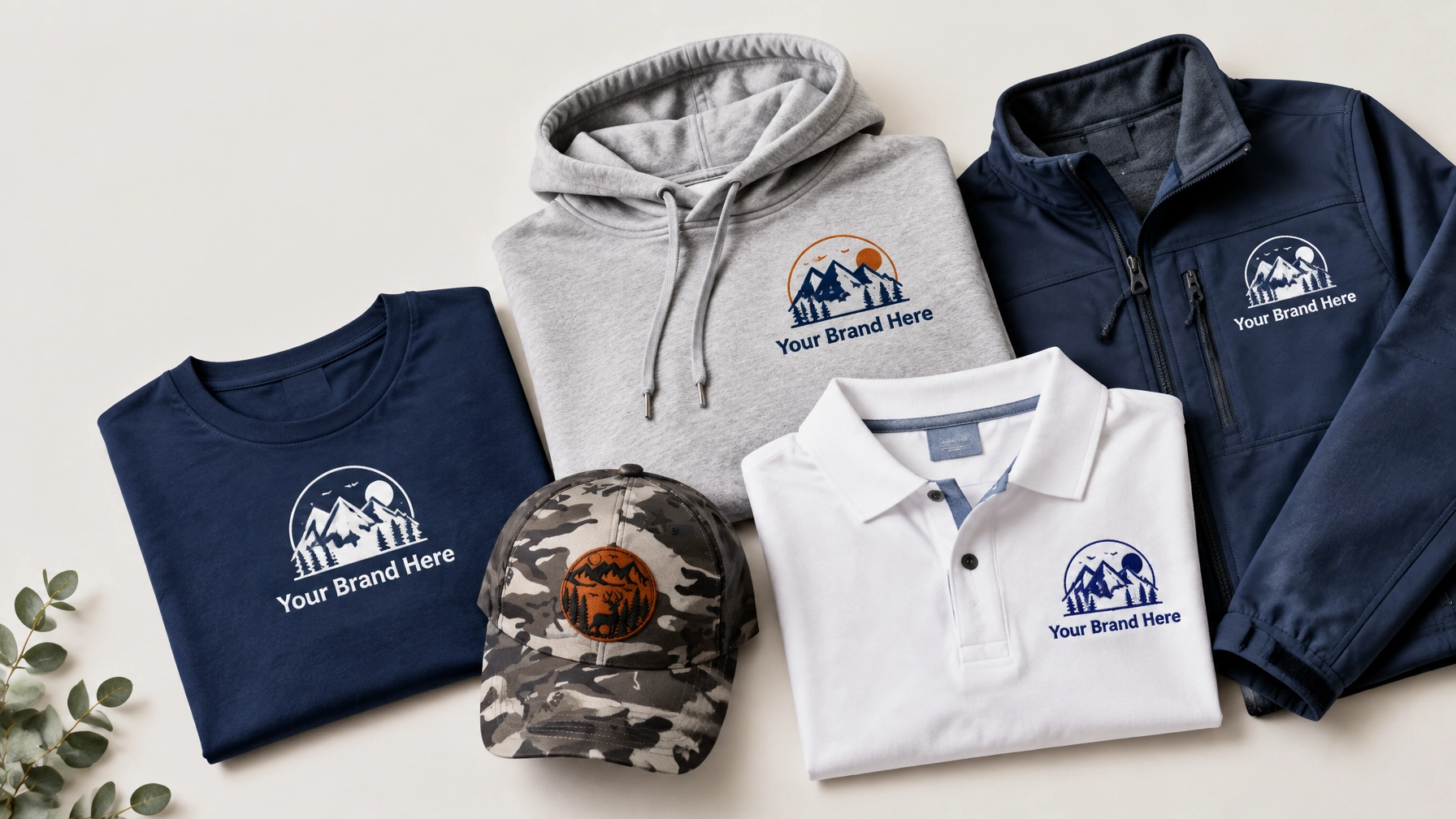
- Embroidery: Perfect for hats, polos, and outerwear where you want a premium, textured look.
- Sublimation: Ideal for “all-over” prints on performance wear.
When you work with a broker like AKOR Services, we look at your design and your budget to recommend the promotional products and printing method that makes the most sense.
3. Ignoring the “Contrast Rule”
We all have a favorite color, but that doesn’t mean it’s the right choice for your apparel project. A common mistake is choosing an ink color that is too similar to the garment color. For example, navy blue ink on a black t-shirt might look sleek in a digital mockup, but in real life, it’s almost invisible.
Similarly, neon colors can look vastly different depending on the base fabric. Fluorescent yellow ink on a white shirt won’t pop nearly as much as it would on a dark grey or black shirt.
The Fix: Always prioritize legibility. If you want your logo to be seen from across the room, go for high contrast. Dark garment? Use light ink. Light garment? Use dark ink. If you are unsure, ask for a digital proof that shows the colors side-by-side. We can help you visualize how your brand colors will interact with different fabric dyes.
4. Guessing the Sizing Distribution
It’s easy to think, “I’ll just order 25 of each: Small, Medium, Large, and Extra Large.” While that seems balanced, it rarely matches the reality of a modern group. Often, you’ll end up with a pile of Small shirts that no one can wear and a line of people asking if you have any 2XLs left.
Neglecting the inclusive side of sizing is a major mistake. If your team or customers feel left out because the “standard” sizes don’t fit them, the branding effort can actually backfire.
The Fix: If you have the time, do a quick poll of your team. If you’re ordering for a general event, follow the “Standard Bell Curve” of sizing, which usually leans more toward Large and XL. Also, don’t forget to order a few 2XL and 3XL options. It’s always better to have a slightly loose shirt than one that can’t be worn at all.
5. Forgetting About Fabric Content
A t-shirt isn’t just a t-shirt. The material it’s made of changes how it fits, how it feels, and how it prints.
- 100% Cotton: Breathable and great for screen printing, but prone to shrinking.
- Polyester Blends (CVC or Tri-blends): Incredibly soft and hold their shape well, but they require specific inks to prevent “migration” (where the shirt color bleeds into the ink).
- Performance/Wicking Fabrics: Great for the gym, but they can be tricky for certain types of heat transfers.
The Fix: Consider the environment where the apparel will be worn. Are these for construction workers out in the sun? Go for moisture-wicking or heavy-duty cotton. Are these for a tech startup office? A soft tri-blend will be a huge hit. Check out our about us page to see how we prioritize quality in every product we source.
6. Waiting Until the Last Minute
We get it, life moves fast. But custom apparel isn’t an “Amazon Prime” situation where you can click a button and have it tomorrow. Quality printing takes time. There’s artwork approval, garment sourcing (making sure the shirts are actually in stock), setup, printing, drying, and shipping.
When you rush an order, you run the risk of paying high rush fees, or worse, having to settle for a second-choice garment color because your first choice wasn’t available for immediate shipping.
The Fix: Aim to start your order at least 3 to 4 weeks before you actually need the items in your hands. This gives us plenty of time to troubleshoot any artwork issues and ensure the shipping carriers don’t cause a heart attack by delivering a day late.
7. Skipping the Proof Review
When we send over a digital proof, it’s tempting to just give it a quick glance and hit “Approve.” But the proof is your final contract. This is the moment to check for spelling errors (yes, even in your own company name!), logo placement, and sizing. Once the ink hits the fabric, there is no “undo” button.
A common placement mistake is the “Belly Print.” If a logo is placed too low on a shirt, it ends up sitting on the stomach rather than the chest, which isn’t flattering for anyone.
The Fix: Look at the proof on a computer screen, not just a phone. Check the dimensions. Is the logo 3.5 inches wide or 5 inches wide? Use a ruler against your own chest to see how that actually looks. Verify the spelling of every single word. If something looks off, contact us immediately. We would much rather fix a PDF than a thousand shirts.
Why Work with AKOR Services?
The common thread in all these mistakes is a lack of communication or technical knowledge. That’s exactly where we come in. As a broker, AKOR Services, LLC works with a network of high-end printers and manufacturers. We know which shops excel at embroidery and which ones have the best DTG machines in the country.
We handle the technical specs, the follow-ups, and the quality checks so you can focus on running your business. Our goal is to make sure your brand looks professional every single time. Whether you’re looking for basic tees, high-end outerwear, or unique promotional items, we’re here to guide you through the process from start to finish.
Ready to start your next project without the stress? Let’s chat about what you’re looking for.
AKOR Services
(360) 334-3373
Allen@akorservices.com
All Rights Reserved, AKOR Services, 2026